
Cosmetic restorations
Veneers and laminates
Thin ceramic restorations planned around your natural teeth, from minimal-prep options to same-day CEREC veneers designed and milled in one visit.
Why plan veneers with us
Smile design in one plan
Shape, shade and gum line are planned together against your own face and remaining teeth, not a fixed template.
Designed and milled with CEREC
AMInate ceramic veneers are designed and, for suitable cases, milled in the clinic the same day with our CEREC CAD/CAM system.
Minimal-prep considered first
No-prep and minimal-prep options are considered before more tooth structure is removed, where your case allows.
Repair and appearance together
Where a front tooth has decay or an old filling, a veneer can sometimes replace the compromised surface and improve its appearance in the same restoration.
Who we usually assess for veneers
Whether a no-prep laminate, a minimal-prep veneer, or a different restoration suits you is decided only after an examination. Significant crowding or a jaw/bite problem is usually assessed for orthodontic treatment, such as AMIsalign, before or instead of veneers — see "What veneers can change" below.
Uneven tooth shape or length
Front teeth that are chipped, worn or uneven in length.
Discoloration that whitening cannot fully address
Staining or discoloration from inside the tooth, not on the surface.
Minor gaps or overlap
Small spacing or overlap in the front teeth that does not require orthodontic movement.
Worn or discolored old restorations
Replacing older crowns, bonding or laminates that no longer match the rest of your smile.
Decayed or heavily filled front teeth
A front tooth where an old filling, decay repair or heavy wear affects both strength and appearance, where a veneer can be considered for both at once.
How treatment works
Consultation and design
Examination, photos and a digital scan, and a discussion of shape, shade — including whitening and the gum line — and how much natural tooth, if any, needs to be prepared.
Preparation (if needed)
Minimal or no tooth preparation for no-prep laminates; more conventional preparation for all-ceramic veneers or crowns.
Fabrication
Veneers are designed digitally and either milled the same day with CEREC or fabricated at a dental laboratory, depending on the case.
Fitting and bite check
Veneers are bonded in place and your bite is checked so chewing forces are distributed evenly.
What veneers can change — and what needs orthodontics
AMInate veneers are an honest, surface-level change: they reshape and recolour the front of a tooth. They do not move teeth through the bone or correct a bite.
This table is a general guide, not a diagnosis. Your dentist confirms which column applies to you after an examination.
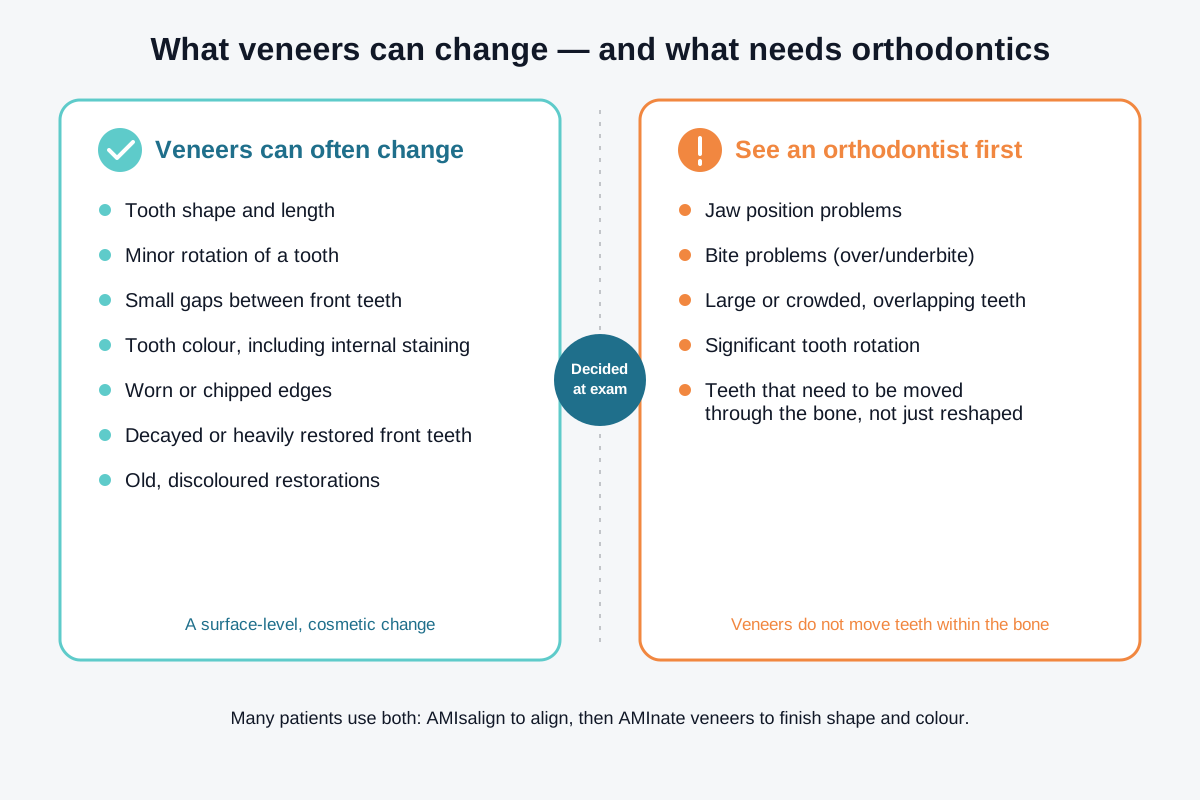
| Concern | Veneers | Orthodontics (e.g. AMIsalign) |
|---|---|---|
| Tooth shape, length or worn edges | Usually yes — reshaped with ceramic | Not needed for shape alone |
| Colour, including internal staining whitening cannot reach | Usually yes | Not applicable |
| Small gaps or minor rotation | Often yes, by reshaping the surface | An alternative if you prefer to close gaps by moving the teeth |
| Decayed or heavily restored front teeth | Often yes — can replace a compromised surface and improve appearance together | Not applicable |
| Large crowding or significant rotation | Not on its own — would need excessive tooth reduction | Recommended first, sometimes combined with AMInate afterward |
| Jaw position or bite problems | No — veneers do not move teeth or the jaw | An orthodontic assessment is needed |
No-prep, minimal-prep, or a crown?
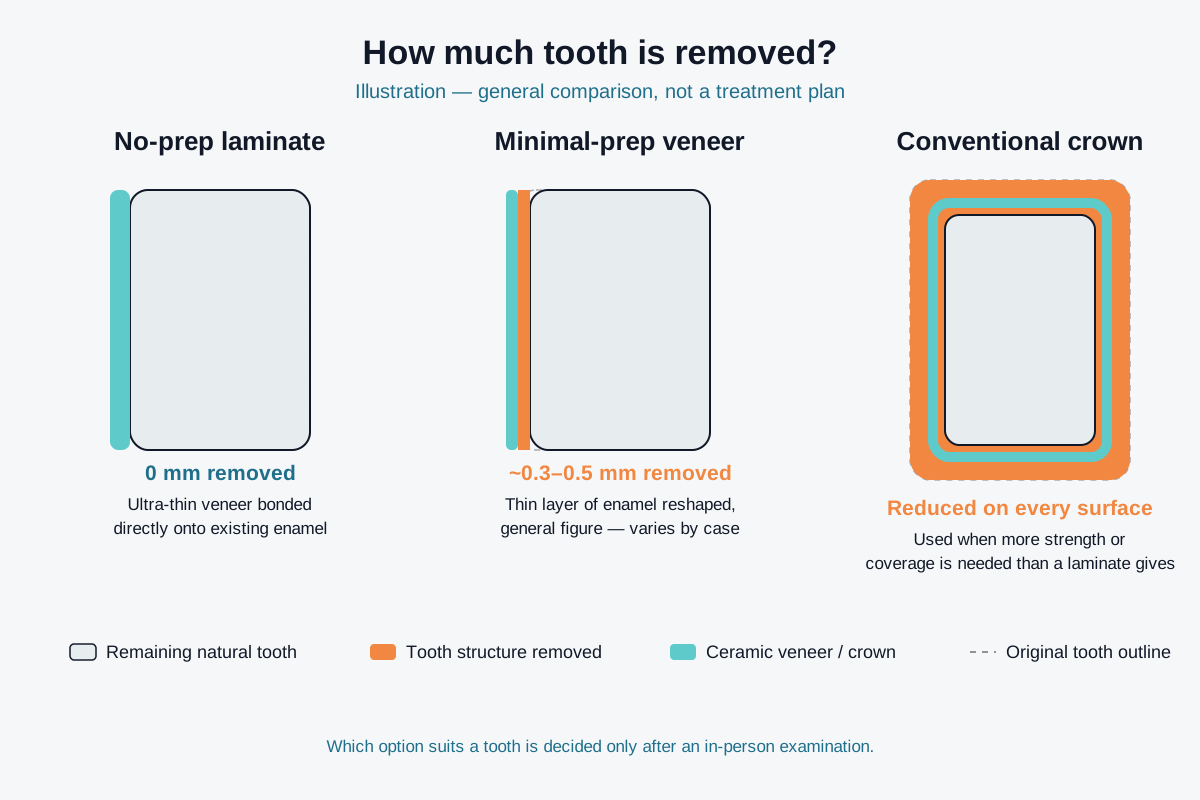
"No-prep" describes how much natural tooth is removed before a restoration is bonded on. We consider the option that removes the least tooth structure first, where your case allows.
Enamel that has been removed does not grow back, so we only recommend removing tooth structure when a no-prep option would not give a stable, natural-looking result.
No-prep laminate
An ultra-thin ceramic layer bonded directly onto the existing enamel surface, with little to no reshaping. Tends to suit teeth that are not already prominent or discoloured from within.
Minimal-prep veneer
A thin layer of enamel — roughly 0.3 to 0.5 mm as a general figure — is reshaped so the veneer sits flush and blends naturally. The exact amount depends on your tooth and is confirmed at your consultation.
Conventional crown
Used when a tooth needs more strength or coverage than a thin veneer can give. The tooth is reduced on every surface so a crown can wrap fully around it.
AMIsalign then AMInate: an integrated plan
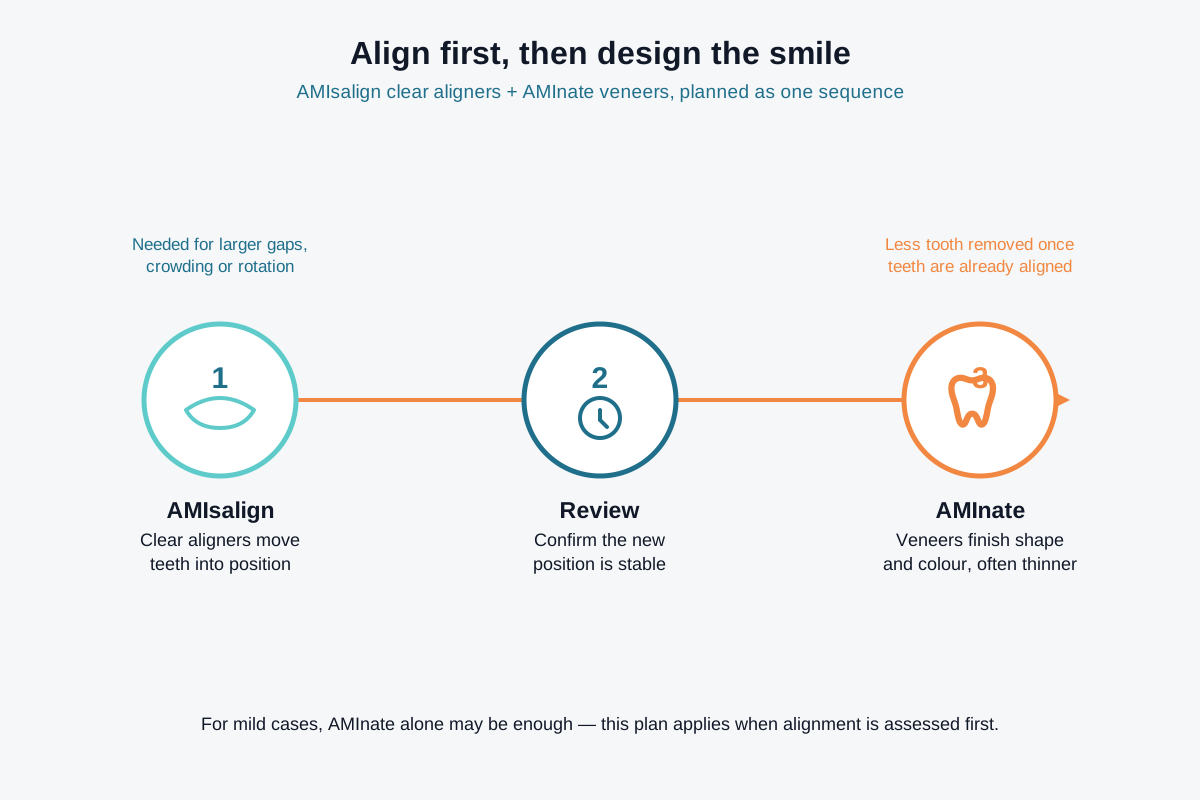
For teeth that need both straightening and reshaping, we can plan AMIsalign clear aligners and AMInate veneers as one sequence rather than two separate decisions.
Not every case needs this sequence. Minor shape or colour concerns can often go straight to AMInate; your dentist tells you which applies after an examination.
Align with AMIsalign first
Clear aligners move the teeth into a better position, addressing larger gaps, rotation or crowding that veneers alone could not correct.
Review and confirm stability
Once the planned movement is complete, we check that the new position is stable before any tooth is prepared for a veneer.
Finish with AMInate
With the teeth already in position, veneers can often be thinner, no-prep or minimal-prep, and are planned purely for shape, length and colour.
Smile design: shade, whitening and the gum line together
Veneers are planned as part of your whole smile, not one tooth in isolation — shade, any whitening, existing crowns or fillings, and the gum line are considered together.

Shade matched to your whole smile
Veneer shade is chosen against your remaining natural teeth, not a generic white, so the result reads as one smile.
Coordinated with whitening
If whitening is part of your plan, we usually whiten first and let the shade settle, then match veneers and any new restorations to the whitened result.
Matched to existing restorations
Older crowns, bonding or fillings in the smile zone are reviewed so they do not stand out once the new veneers are placed.
Gum line and proportion
Where the gum line is uneven or a tooth looks short because of excess gum, gentle gum contouring can be planned alongside the veneers to even out the smile.
One-visit treatment for suitable cases
Because AMInate veneers can be designed and milled in the clinic with CEREC CAD/CAM, a few teeth can sometimes be scanned, designed, milled and bonded in a single visit.
This fits a small number of teeth with straightforward shade matching. Larger cases, more complex shade work, or cases following the AMIsalign sequence above are usually planned over 2 to 3 days and sent to a dental laboratory.
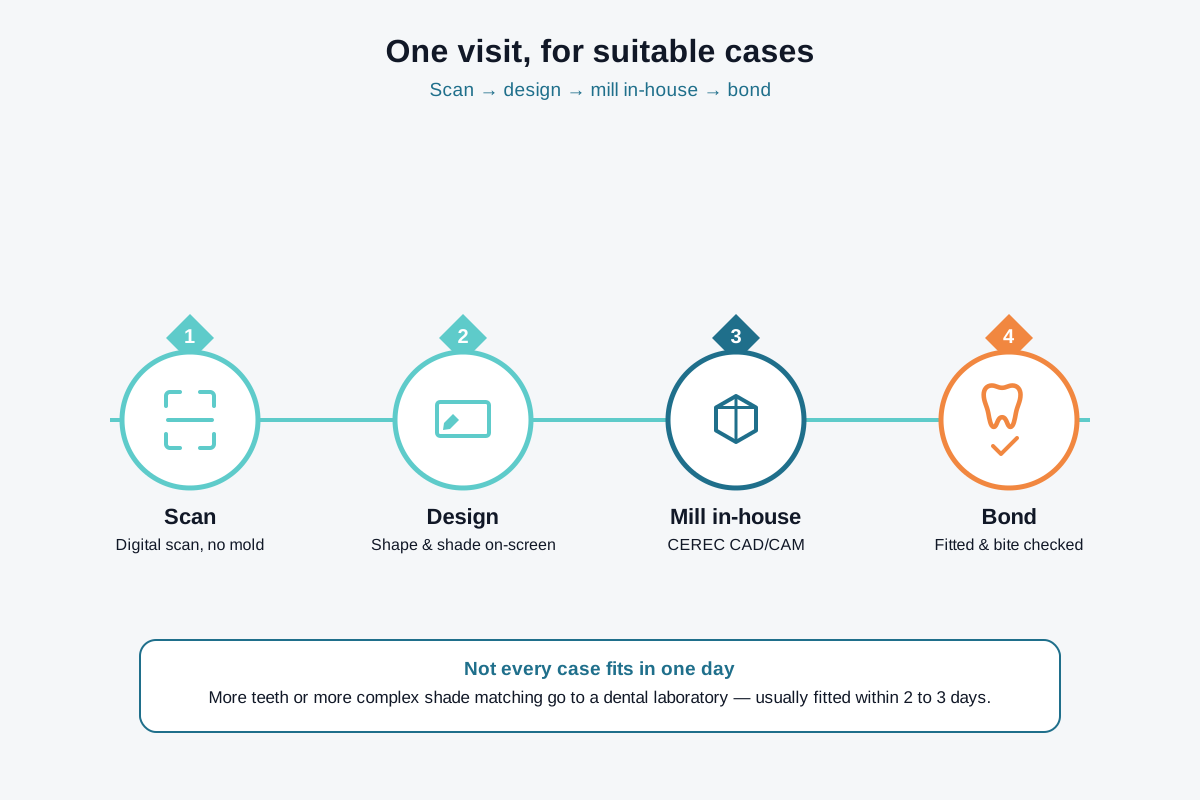
Scan
A digital intraoral scan replaces a traditional mold.
Design
Shape and shade are designed on-screen and reviewed with you before any ceramic is made.
Mill in the clinic
Our CEREC CAD/CAM system mills the veneer from a ceramic block in the clinic.
Bond
The veneer is bonded and your bite is checked before you leave.
AMInate for patients from abroad: finished in one visit
Because AMInate veneers are designed and milled in the clinic with CEREC CAD/CAM, most cases are completed on the day of treatment or within 2 to 3 days — see the one-visit workflow above for how a same-day case is planned.
Shade and shape are confirmed with you at the try-in. If a case needs orthodontic correction first, we say so at the review rather than fitting veneers.
Before you travel
Send photos, and an X-ray if you have one, through the estimate form. We tell you how many teeth are suitable, what the design would involve and how many days to plan for.
Day 1: examination, design and preparation
Examination, digital scan and smile design on screen. Teeth are prepared the same day; cases of a few teeth can be milled and bonded in one visit.
Day 2 to 3: larger cases fitted
For more teeth, a dental laboratory fabricates the veneers overnight and they are tried in, adjusted and bonded before you fly home.
Veneer and laminate options
We compare these options against your tooth structure and goals at your consultation.
AMInate Essential
Our standard ceramic veneer line for everyday cosmetic correction.
AMInate Signature
A higher-specification tier of our ceramic veneer line for more demanding aesthetic cases.
No-prep laminate
An ultra-thin laminate placed with little to no removal of the natural tooth surface, where the case allows.
All-ceramic veneer or crown
A fully ceramic restoration for cases needing more coverage or strength than a thin laminate provides.
One-day CEREC veneer
Designed and milled in-house in a single visit for suitable cases, using our CEREC CAD/CAM system.
Frequently asked questions
What is the difference between a laminate and a veneer?
Both are thin restorations bonded to the front of a tooth. "No-prep" laminates remove little or no natural tooth structure; all-ceramic veneers usually involve more conventional preparation. Your dentist recommends an option after assessing your teeth.
Can veneers be done in one visit?
For suitable cases, our CEREC CAD/CAM system can design and mill a veneer the same day. More complex cases are fabricated at a dental laboratory and fitted at a second visit.
Will my veneers match my other teeth?
Shade and shape are planned against your remaining teeth at your consultation.
How should I care for veneers?
Avoid biting very hard or sticky foods, do not use your front teeth as tools, and keep up regular cleanings. Your dentist gives you specific aftercare instructions.
Can whitening be done instead of veneers?
If discoloration is on the tooth surface, whitening may be enough. Veneers are usually considered when shape, internal discoloration or more extensive correction is needed.
Do veneers feel different from natural teeth?
Most patients adjust within a short period. Some sensitivity can occur, especially where tooth preparation was needed.
Can veneers fix crooked teeth?
Veneers can adjust minor rotation or small gaps by reshaping the tooth surface. Larger crowding or rotation usually needs an orthodontic assessment, sometimes combined with AMIsalign aligners before AMInate veneers finish the shape and colour.
What does "no-prep" actually mean?
It means little or no natural tooth is removed before the veneer is bonded on. Where more correction is needed, a minimal-prep veneer removes a thin layer of enamel — roughly 0.3 to 0.5 mm as a general figure — and a crown removes more on every surface. Your dentist tells you which applies to your tooth.
Can a veneer treat a decayed front tooth as well as improve how it looks?
Often yes. A veneer can replace a compromised surface from an old filling or decay while also correcting its shape and colour, where the tooth is otherwise suitable for a veneer rather than a root canal or crown. This is decided at your examination.
Is gum contouring part of a veneer smile design?
Where the gum line is uneven or a tooth looks short because of excess gum, your dentist may suggest gentle gum contouring alongside the veneers so the smile line looks even. This is assessed and discussed at your consultation.
Plan your veneers or laminates
Book a consultation in Seoul to discuss your options and see which fits your teeth and goals.
Treatment plans, duration and costs depend on each patient's oral condition. Side effects such as pain, tooth sensitivity or gum inflammation may occur. Treatment is decided only after a dentist has examined you.