
Implant dentistry
Dental implants, planned stage by stage
An implant replaces a missing tooth root, and the timeline depends on your bone and gums as much as the procedure itself. We plan each stage with you before we start.
Why plan implants with us
We try to save the tooth first
Our starting point is always whether a tooth can still be treated and kept. An implant is offered once keeping the natural tooth is no longer realistic.
Same-day placement when the socket allows
At our clinic, 90% of extractions are followed by same-day implant placement (clinic records; depends on each patient's condition), confirmed case by case once the tooth is actually removed.
Gum, shade and bite planned as one result
Gum contouring, a shade matched across your smile — including the prosthesis — and a balanced bite are planned together with the implant itself, not treated as afterthoughts.
Who we usually assess for implants
Whether an implant, a bone graft, or another restoration suits you is decided only after an examination and imaging.
A single missing tooth
Replacing one tooth lost to decay, gum disease or injury.
A missing front tooth
Cases where the visible result of the gum line and crown shape matters as much as function.
Multiple or all teeth in an arch
Cases replacing several teeth or a full arch, planned with the number and position of implants needed to support it.
Reduced bone volume
Cases where bone has resorbed after tooth loss and a bone graft or sinus lift is assessed first.
A tooth that cannot be saved
When a tooth must be removed, the socket is assessed on the spot for same-day implant placement, as an alternative to waiting for the site to heal first.
How treatment works
Can the tooth be saved first?
Before any implant is planned, we check whether the tooth itself can still be treated and kept. An implant is discussed only once saving the natural tooth is no longer realistic.
Examination and planning
A panoramic X-ray and a digital intraoral scan show your bone height and the position of nerves and sinuses, and digital planning maps the implant position in advance. If a tooth must be extracted, the socket is also assessed for same-day placement.
Placing the fixture
The implant fixture is placed under local anesthesia, typically in under an hour for a single site. Swelling for a few days afterward is normal.
Healing and integration
Bone grows onto the fixture in a process called osseointegration. This typically takes about 2 to 6 months, depending on bone quality, site and whether a graft was needed.
Abutment and final crown
Once integration is confirmed, an abutment and a digital scan lead to a final crown, shade-matched to your smile, with the bite carefully checked and adjusted before you leave.
Immediate implant placement after extraction
When a tooth cannot be saved, we check at the time of extraction whether an implant can go into the same socket that day, rather than waiting for a separate healing period before placement.
See our dedicated immediate-placement page for how the decision is made and what happens when a socket does not qualify.
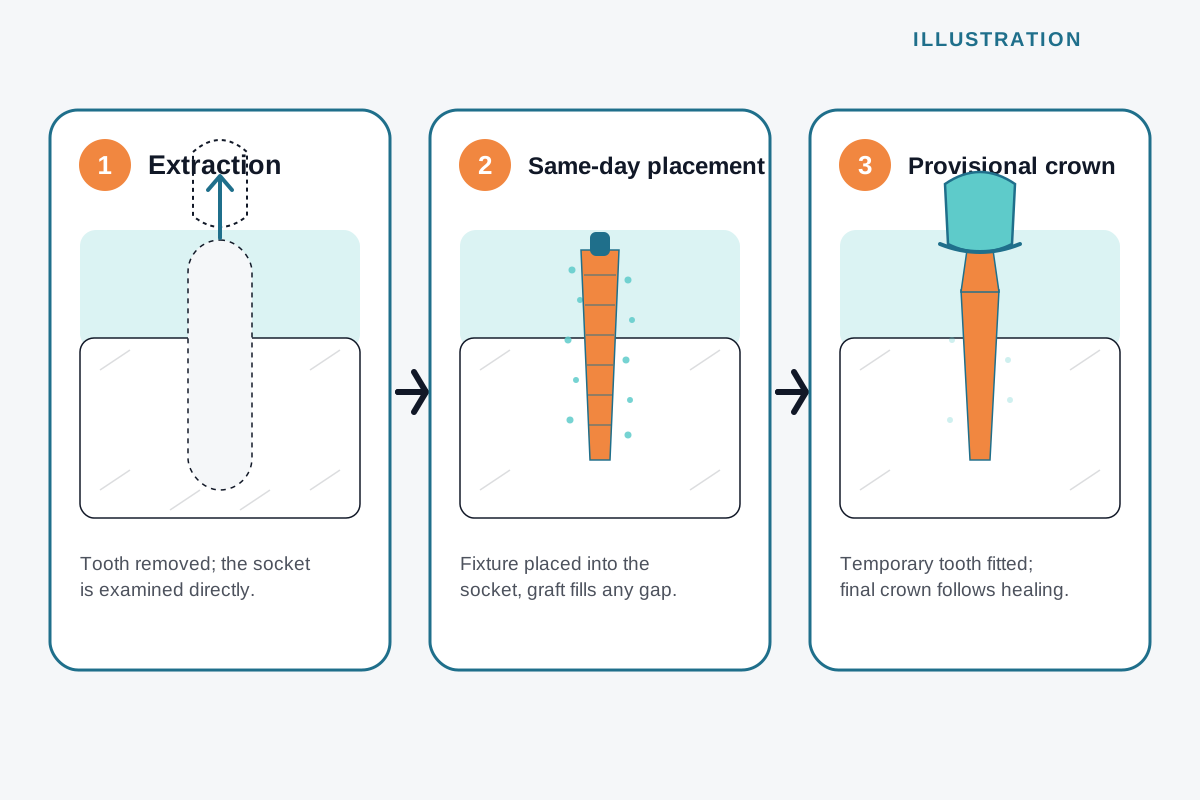
Same-day placement in 90% of extractions
At our clinic, 90% of extractions are followed by same-day implant placement (clinic records; depends on each patient's condition) — confirmed case by case once the tooth is actually removed.
The socket decides, not the calendar
An infected, fractured or bone-deficient socket often needs to heal first, or needs a bone graft, before an implant can be placed safely.
One surgical visit instead of two
When the socket qualifies, placing the implant the same day can mean one surgical appointment rather than extraction, a healing wait, and a separate placement visit later.
Gum reconstruction and contouring
Healthy, well-shaped gum tissue is part of how an implant looks and functions, not a separate concern. We assess the gum around an implant site the same way we assess the bone.
Whether gum reconstruction or contouring is needed, and what it can realistically achieve, is judged at your examination — not promised in advance.
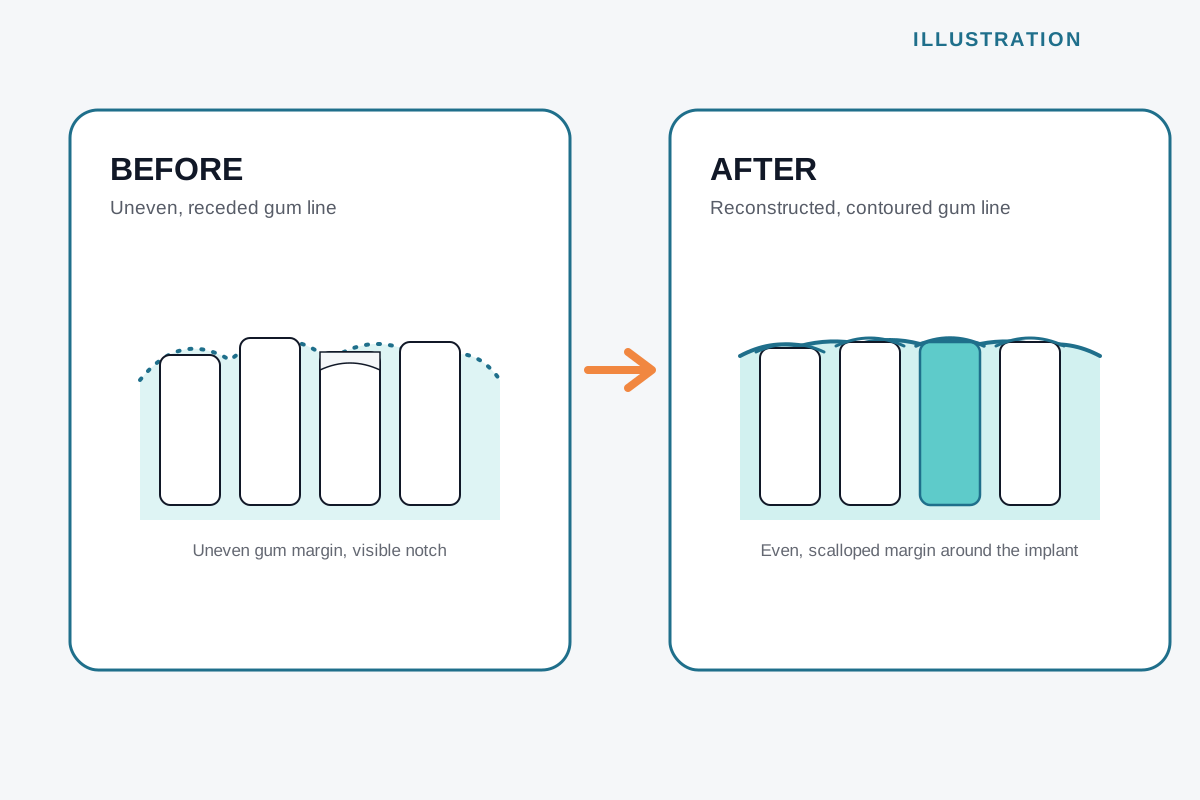
Rebuilding lost gum tissue
Where gum tissue has receded or thinned around a tooth site, reconstruction can restore coverage and support before or around implant treatment.
Contouring for a natural line
Gum shaping (gingival contouring) evens out the gum line around an implant crown and its neighbors, so the result reads as a settled, natural smile.
Part of a fresher-looking smile
Restoring and contouring the gum line is part of what can give a reconstructed smile a fresher, more youthful appearance, alongside the implant itself.
Tooth-preserving treatment first
An implant replaces a tooth root — it does not replace a tooth that could have been treated and kept. Before recommending an implant, we check whether your tooth still has a future.
An implant is recommended only once these options have been considered and ruled out for your specific tooth.
- Root canal treatment and a crown, where the tooth structure and supporting bone allow it
- Gum (periodontal) treatment, when disease rather than the tooth itself is the main problem
- A splint, a build-up or a partial restoration, for a cracked or heavily worn tooth that can still function
- Monitoring a borderline tooth over time, instead of removing it immediately
Shade-matched, bite-balanced prosthetics
The crown or bridge on your implant is planned as part of your whole smile, not as an isolated restoration — matched in shade and checked against how your upper and lower teeth meet.
Shade and bite are planned together at your final crown appointment; results depend on your natural teeth and bite and cannot be guaranteed in advance.
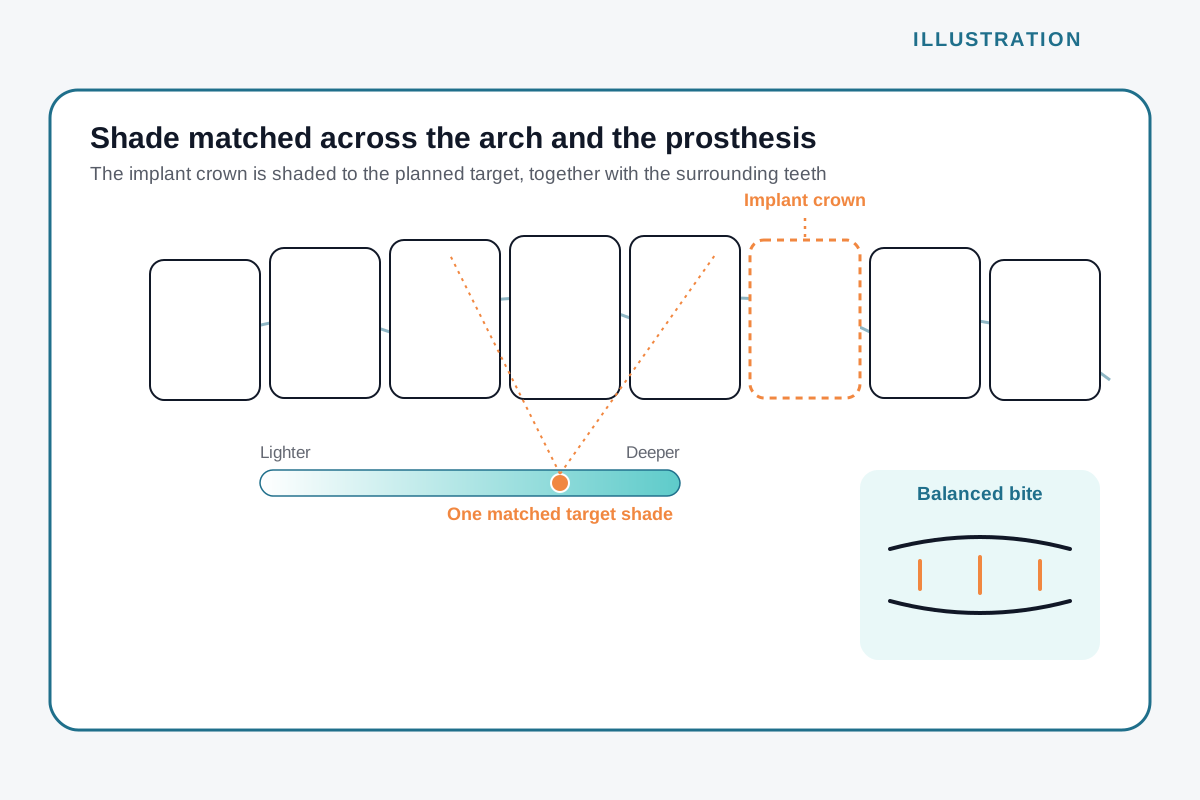
One shade target for the whole smile
The implant crown's shade is planned against your natural teeth and, where more than one tooth is being restored, against each other, so the result reads as one smile rather than a mismatched repair.
Occlusion checked, not assumed
How the new tooth meets its opposite number is checked and adjusted at fitting, since a high or uneven contact can cause discomfort or strain over time.
Adjusted in the clinic with CEREC CAD/CAM
Shade and bite adjustments to the crown or bridge are designed and milled in the clinic with CEREC CAD/CAM, so nothing waits on an outside laboratory.
One-week implant program for patients from abroad
Multiple-implant and full-arch cases can be completed in a single trip when the preparation is done before you travel. The schedule follows the same staged approach we use for patients who come to Seoul from other regions of Korea.
Whether your case fits this program is decided from your X-ray and examination. Bone grafting or a sinus lift adds healing time and may need a second visit.
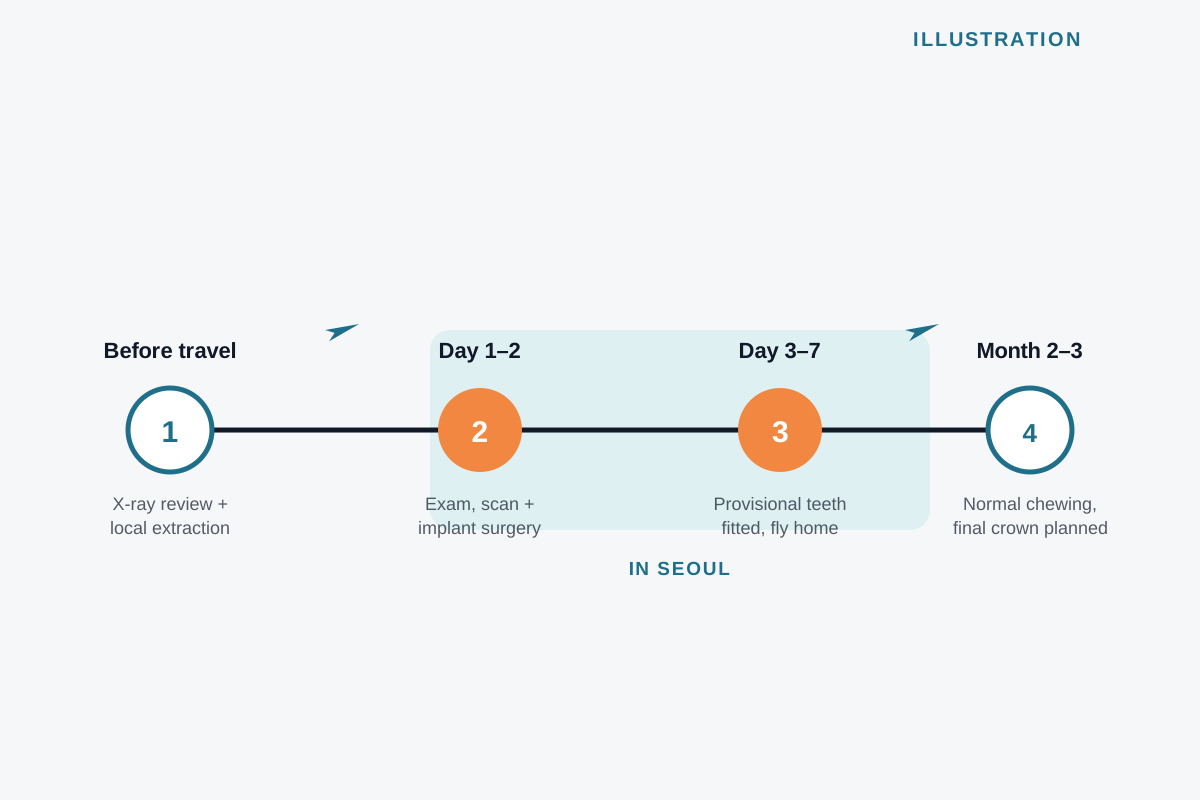
Before you travel: panoramic X-ray review
Send a recent panoramic X-ray and photos through the estimate form. Dr. Lee checks the bone, the remaining teeth and the sinus position, and tells you what can be done in one visit.
Extractions at home, healing before the trip
Teeth that cannot be kept are removed by your local dentist well before you travel, so you arrive with healed gums. This is what makes a one-week schedule possible.
Day 1 to 2 in Seoul: examination, scan and surgery
Examination, digital scan and X-ray, then implant placement under local anaesthesia. We use Osstem implants.
Day 3 to 7: provisional teeth fitted
A provisional fixed prosthesis is made for you before you fly home, so you leave with teeth in place.
From 2 to 3 months: normal chewing
Implants need time to integrate with the bone. Following the implant maker's guidance for the Osstem SOI surface, normal chewing on the new teeth begins about 2 to 3 months after surgery, and the final prosthesis is planned with you at that stage.
Looking after your implant
An implant has no periodontal ligament, the tissue that lets a natural tooth sense pressure — so inflammation around it can progress with little warning if it is not checked regularly.
Daily cleaning
Clean around the implant as instructed, including any interdental brushes your dentist recommends.
Regular check-ups
Keep up professional cleanings and check-ups, even if you live abroad and see a local dentist most of the time.
Keep your records
Ask for your implant system and fixture specifications so a dentist in your own country can service the restoration if needed.
Report issues early
Tell us about any bleeding or looseness as soon as you notice it, rather than waiting for pain.
Implants for patients with diabetes
Well-controlled diabetes does not rule out implant treatment, but it is a factor we review closely during planning and healing, since blood sugar control affects how predictably bone heals around an implant. Tell us about your diagnosis, medication and recent blood sugar control at your consultation so we can plan accordingly.
Insurance basics for implants
Korean National Health Insurance implant coverage applies to Korean residents who meet specific age and eligibility rules — it generally does not apply to international patients visiting for treatment. This section is background information only; ask us about documentation for your own insurer.
Age and eligibility (Korean NHI)
Korea's National Health Insurance implant benefit is limited to patients aged 65 and over with a partially edentulous jaw, up to two implants per lifetime under the scheme.
For international patients
If you are visiting from abroad, your treatment is typically billed as a non-covered (self-pay) procedure. We can issue receipts and treatment summaries for your own insurer.
GEHA insurance
We support documentation for GEHA insurance for U.S. federal civilian and military personnel.
Frequently asked questions
How long does an implant take from start to finish?
As a rough shape: one visit for examination and placement, a healing gap of about 2 to 6 months, then a second visit for the abutment and crown. Simple cases can be shorter and complex ones longer.
Can I plan implant treatment around a short trip to Seoul?
Many international patients split implant treatment across two trips, spending the healing period at home. Tell us your travel dates at the planning stage.
Do I need a bone graft?
Only if your scan shows reduced bone volume at the planned site. We confirm this at your examination, not before.
Does getting an implant hurt?
It is placed under local anesthesia and most patients describe the experience as more manageable than expected, though this varies from person to person. Swelling for a few days afterward is normal.
What happens if I have diabetes?
Tell us at your consultation. Well-controlled diabetes does not rule out treatment, but it is factored into planning and healing time.
How do I look after an implant long term?
Daily cleaning and regular professional check-ups, since an implant can develop inflammation with less warning than a natural tooth.
Can I get an implant the same day a tooth is removed?
Sometimes. At our clinic, 90% of extractions are followed by same-day placement (depending on each patient's condition), but this is only confirmed once the tooth is out and the socket is examined — see our immediate placement page for detail.
Will the gum around my implant look natural?
Gum reconstruction and contouring are planned when needed, to even out the gum line around the implant and its neighboring teeth.
Will my implant crown match the rest of my teeth?
Yes — the crown's shade is planned against your natural teeth, and against the rest of the restoration when more than one tooth is involved, so the result reads as one smile.
What if my bite feels off after the crown is fitted?
Tell us straight away. The bite is checked and adjusted at fitting, and can be refined afterward if something still feels high or uneven.
Plan your implant treatment
Book a consultation and scan in Seoul, or send us your dates in advance so your visits can be planned around them.
Treatment plans, duration and costs depend on each patient's oral condition. Side effects such as pain, tooth sensitivity or gum inflammation may occur. Treatment is decided only after a dentist has examined you.